| Contact Us | FAQ | Features | Test Frequencies | Test Process | Test Report | Home |
Our Field Service Grade RF test cables are inspected and tested to the most exacting standards in the industry. No other manufacturer tests to the degree that we do!
The following tests are performed on every cable manufactured:
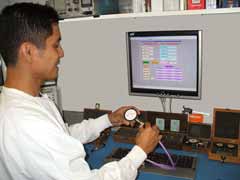
Mechanical Testing
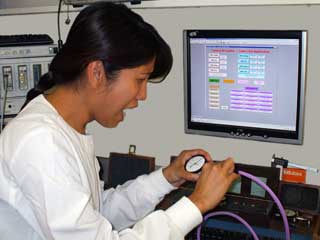
Pin Depth - We use precision connector pin depth gages to ensure that center pins are within acceptable limits For N, BNC, TNC, and SMA connectors. It should be noted that an incorrect pin depth can cause damage to mating connectors or lead to intermittent/inconsistent connections.
Other connector types have fixed center pins and do not require gaging the pin depth.
General Purpose TDR - With a fast sweep time the cable is flexed while observing the TDR trace. Any changes in the trace and we will reject this test cable. Our cables MUST be stable.
Dielectric Test - A Megohmmeter is used and a 500V test voltage
applied. A greater than 100 MOhm reading must be obtained. This test will
reveal defects such as a damaged dielectric or stray strands of the shield
material.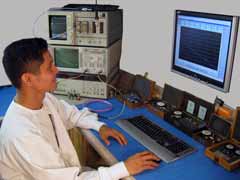
Precision TDR - A very high bandwidth TDR system is used to verify that the cable and connectors meet their reflection coefficient specifications. Any issues with the mechanical dimensions of cables or connectors will be revealed by this test. Trace data is supplied on the test report.
S21 Transmission Loss - A Vector Network Analyzer is used to sweep the cable and determine very accurately the test cable insertion loss. Trace data is supplied plus it is also provided in a marker table with 8 data points. Standard LMR Band marker frequencies are 150, 300, 450, 600, 700, 800, 900, and 1000 MHz. See the Test Frequencies page for other standard bands. Custom marker frequencies can be provided at your request. All this information is provided on the test report.
Quality Control at Work - Don't mess up around here!